
When did we decide that we always have to be perfect?
This week I question whether or not perfect is good, get advice from a founder about collaborations, and round up all the latest ways to spoil yourself, and been printing stuff with a 3D printer.

When did we decide that we always have to be perfect?
I’ve just read an article about how university students are turning to AI to make sure that their essays are the best they can be, for fear of being caught out for not knowing the right answers.
We all strive to be better, myself included, and AI now makes that even easier.
When I first started running Pocket-lint, there was an acknowledgement that for the most part you made it up as you went along.
You made mistakes, learnt from those mistakes, and then eventually found the right path to proceed until you came to the next challenge and next mistake.
Today, I’m not so sure.
I’m currently in the process of hiring a sales director at Squirrel and have come to realise the candidates I’m talking to have many of the answers I don’t; a good place to be.
For me, AI gets me some of the answers, but doesn’t help me fully understand how we got there.
Who needs to figure it out for themselves?
But just like school, where you had to show your workings, the process of getting the right or wrong answer can be the most important part of the journey.
The difference between the students and me is they aren’t happy to acknowledge they don’t have all the answers, and while hard for me, I’ve already accepted I need to fill the gaps in my expertise.
Being imperfect is part of the process. The good news is that I’m still happy to make mistakes, because a day without a mistake is a day wasted.
Founder advice: Be willing to shift from autocracy to collaboration
Top tips from successful founders
I‘m Mel Morris CBE, a CEO and co-founder of Corpora.ai. It’s an AI research engine focused on producing fast, in-depth, and verifiable research across frontier science.
I’m a serial technology entrepreneur, was an early investor and chair of King, the company behind Candy Crush Saga, and have founded, funded, and chaired numerous successful technology businesses, leading them to exits in excess of $7bn.
There is no such thing as a million-pound idea. A good idea is probably worth a pound at best, because the brilliance of a business lies not in the concept itself but in the execution. Entrepreneurs often overvalue what they’ve dreamed up, when in reality, success comes from transforming an idea into a viable business through effort, adaptability, and relentless refinement.
My advice? Work in two-week product cycles to ensure the constant innovation and agility needed for this transformation. Constantly exploring new ways to iterate a product ensures you are pushing your ideas to reach their fullest potential.
As that team and business grow, so must the way decisions get made. Founders must be willing to shift from autocracy to collaboration, and if the moment calls for it, hand over the reins entirely. That last step is easier than it sounds when you focus on creating value rather than protecting your ego. Recognising when to step back is what unlocks the next wave of innovation and, ultimately, larger success.
Questions every founder avoids (but shouldn’t) - #30
Key questions you should challenge yourself to answer
What is it that you do that is hard for others to replicate?
We’ve all heard the phrase, if it was easy everyone would do it.
But what is it that you actually do at your company and what’s the hard part that others would find difficult to replicate?
Working this out, which sometimes isn’t as easy as it sounds, could mean the difference between confusion and clarity in your sales pitch.
And if you can’t pinpoint the why or how, then why not? And more importantly, what could you do to change that? After all, you want to be compared to, not compared against.

Treat yourself
Hot gadget announcements and my take on something worth buying.
Samsung and Google reveal more about their smart glasses collaboration, including the first two designs from Gentle Monster and Warby Parker this autumn
Google used its I/O event to turn up the dial even further on its AI capabilities as it looks to make everything AI-powered including:
More AI search integration expanding way beyond the AI mode in an attempt to fend off chatbots like ChatGPT and Claude - are publishers doomed?
Gemini Omni, a series of models that allow images, audio, video and text inputs to be output as editable video - think next-gen Nano Banana.
Bringing more agentic AI features to Search so you can have agents monitor future searches for you - if this isn’t a path to success for agents, I’m not sure what is.
New Gemini models to make things better, quicker, more intelligent - of course.
Universal cart so Google becomes your shopping basket for every shop - Google wants all your money.
Ask YouTube lets you ask how-to questions to get a video and text that contain the answer - probably easier than watching a dozen plumber videos, right?
Soundcore, Anker’s audio brand, has launched the Liberty 5 Pro Max earphones. The USP? There’s an AI voice recorder for note-taking built right into the charging case. Clever.
Eufy has launched its first robot lawn mower: the C15. It handles up to 500 square metres, will stop when it detects animals like a hedgehog, and costs £999 when it goes on sale in June.
Last week it was a more compact Xbox controller; this week a new Xbox Elite Controller has leaked.
Samsung launches full 2026 TV lineup for you to enjoy, and buy.
After weeks of leaks, Sony marks 10 years of noise-cancelling headphones with premium 1000X The Collexion.
Herman Miller, the guys who make amazing office chairs, has launched its first sit-to-stand Coyl Gaming desk.
If you need further justification to buy a MacBook Neo, Kansas City has just bought more than 4,500 for its students. Wow.
Smart TV stick maker Roku says the way to watch TV today is via projector and, to prove it, has launched two new Roku TV Smart Projectors to let you do just that.
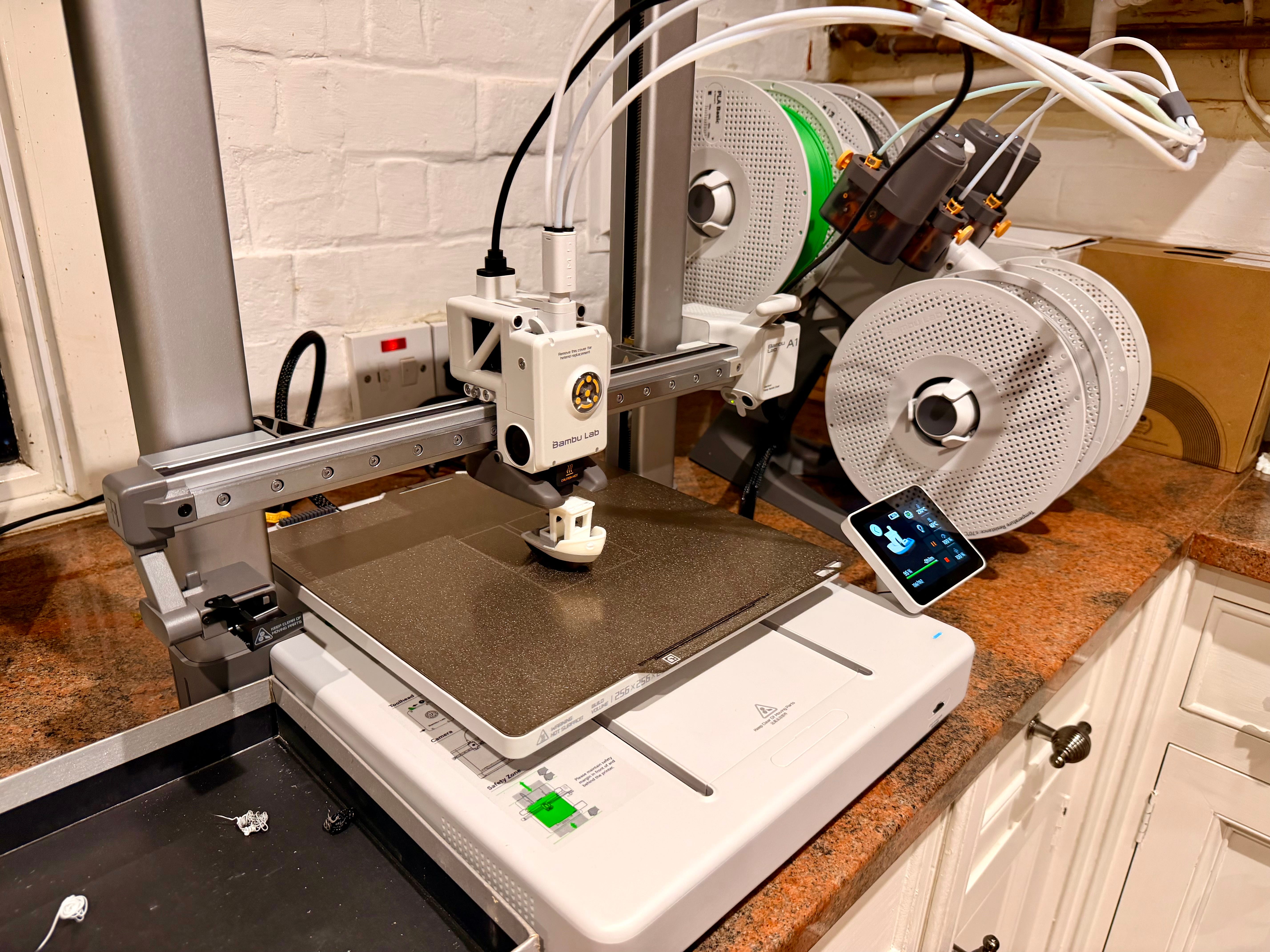
Bambu Lab A1 3D printer review
The Bambu Lab A1 is the entry-level printer offered by Bambu Lab, sitting above the A1 Mini but beneath the more professional P1S. It offers auto-calibration and auto-levelling, and can be controlled via an app.
What I liked
I found the A1 easy to set up, easy to get up and running, and then easy to use. Designed to be bare-bones, the 3D printer can print plenty on its 256 x 256 x 256mm print bed, and if you go for the AMS Lite attachment (I would recommend), you can print up to four colours at once without stopping the print. What makes this even more appealing is the sheer number of designs you have access to on the accompanying app, giving you plenty to get started with. At £319, it’s hard not to like the price too.
What I didn’t like
Although the system has plenty of safeguards in place to try and stop the print going wrong, it can, surprise, surprise, still go wrong. Given that it has a camera built in so you can check on your prints as they happen, it would be great if the system could detect when the print has fails and stop printing. It doesn’t.
Verdict
I’ve tried plenty of 3D printers in the past. They’ve all required you to seemingly have either a degree in quantum physics or the patience of a saint to understand the instructions and go through the calibration process. I found my experience with the A1 to be the complete opposite. If you’re in the market for a 3D printer, you won’t be disappointed.
About Me
If you don’t know me, I’m Stuart Miles. I built Pocket-lint from scratch in 2003, grew it to over 12 million monthly readers, and successfully sold it in 2022. Nearly 20 years of bootstrapping, scaling, and eventually exiting a consumer tech business shapes everything I do now.
Never one to stop, I’m having a second go, building Squirrel, a suite of tools that helps publishers grow and understand their affiliate revenues (as you might expect, if you purchase through links in this newsletter, I may earn an affiliate commission).
I also chair two founder forums at Helm, advise businesses, universities, and industry bodies on strategy and storytelling, and am a BAFTA Games member.
Oh, and I write this newsletter every week 😀.
Thanks for reading.